Freedom of Speech in a World of Constant Noise
July 25, 2026
Everyone's talking. Nobody's listening. Free speech isn't just under attack from governments — it's being drowned out by the noise we built ourselves. Here's what's real.
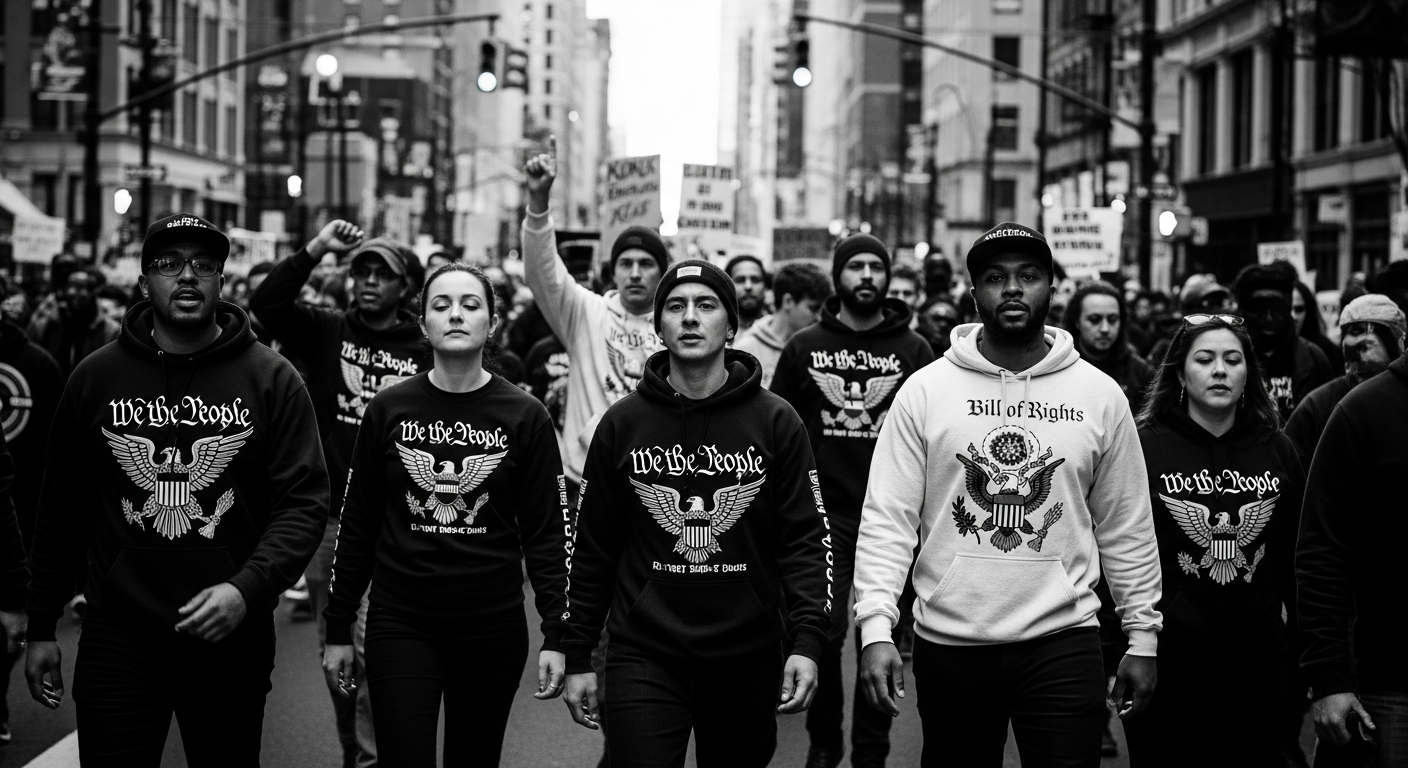
Everyone is talking. Almost nobody is saying anything.
That is the defining contradiction of speech in 2026. We have more platforms, more reach, more tools for expression than any generation in human history — and the public conversation has never felt more hollow, more managed, more afraid of itself.
This is not only a government problem. It is not only a platform problem. It is a problem with what we have done to speech collectively — what the attention economy, algorithmic amplification, and social fear have done to the willingness of ordinary people to say what they actually think, in public, and mean it.
Free speech is in trouble. But not entirely in the way the loudest voices in the debate want you to believe.
Let's be specific.
What Free Speech Actually Is
The Legal Reality — Start Here
The First Amendment to the U.S. Constitution protects you from the government restricting your speech.
That's it. That's what it does.
It does not protect you from your employer firing you. It does not protect you from a private platform removing your content. It does not protect you from social consequences, public criticism, or the loss of your audience. The government cannot jail you for your opinions. Private entities can respond to them however they choose.
This distinction matters because about half the current free speech debate is about the wrong thing — people invoking First Amendment rights in contexts where the First Amendment has nothing to say. Getting the legal baseline right does not resolve the harder questions. But it clears the noise enough to see them.
The Philosophical Reality — Go Deeper
The legal baseline is the floor. The philosophical argument for freedom of speech is the actual foundation — and it is deeper and more demanding than the legal version.
John Stuart Mill laid it out in On Liberty in 1859. Three claims. All still standing.
**Claim 1:** No one is reliable enough to know which opinions are false. History is a graveyard of confidently held errors that were enforced as truths. The Catholic Church was certain Galileo was wrong. The American medical establishment was certain that washing hands before surgery was unnecessary. Confidence in the falsehood of an opinion is not justification for suppressing it — because the mechanism that corrects false beliefs is open contest, and suppression eliminates the contest.
**Claim 2:** Even false opinions serve a purpose. If a true opinion is never challenged, it becomes dead dogma — accepted without understanding, repeated without conviction, defended without argument. False opinions force the holders of true beliefs to actually understand why they are right. This is the productive function of heterodoxy: it keeps true beliefs alive rather than merely inherited.
**Claim 3:** Human flourishing requires the freedom to think and express freely. Enforced conformity doesn't just suppress bad ideas. It suppresses the conditions under which any genuine thinking happens. A society in which people say what they're expected to say rather than what they actually think is a society that has outsourced its cognition to whoever controls the expectations.
Mill acknowledged limits. Shouting fire in a crowded theater. Speech that directly causes harm by its utterance. But the presumption is strongly toward freedom, and restrictions require specific, serious, concrete justification.
That bar is higher than most contemporary arguments for restricting speech come close to clearing.
The Real Threats — Not the Ones You're Being Sold
The culture war version of the free speech debate is a performance. Both sides are using free speech as a weapon rather than defending it as a principle. Here are the threats that are actually serious.
Threat #1 — State Surveillance of Journalists and Dissidents
This is documented. Not theoretical.
The Pegasus spyware revelations — reported by a consortium of journalists in 2021 and confirmed through forensic analysis — showed that governments including Saudi Arabia, India, Mexico, Morocco, Rwanda, and Hungary used sophisticated Israeli-developed malware to compromise the phones of journalists, human rights lawyers, and political opponents. Not suspected criminals. Journalists doing their jobs.
When a government can read every message a journalist sends, access every source contact, track every location, and monitor every communication in real time — that journalist's ability to do investigative work that power does not want done is severely compromised. Not because the government has passed a censorship law. Because it has made the conditions for the practice of journalism dangerous enough that the journalist self-censors or stops.
This is censorship by surveillance. It is real. It is happening now. And it is one of the most serious threats to the freedom of the press — which is not a separate right from freedom of speech but its institutional expression — operating in the world today.
Threat #2 — SLAPP Suits: Using the Law to Silence Critics
SLAPP stands for Strategic Lawsuit Against Public Participation.
The mechanism is straightforward: you are a powerful individual or corporation. A journalist, activist, or ordinary citizen has said something publicly that you dislike — something critical, something damaging to your reputation, something that is also true. You sue them for defamation.
You do not expect to win. You do not need to win. You need the litigation to cost more than the target can afford, to consume enough of their time and resources that they cannot continue doing what they were doing, and to signal to everyone else watching what the cost of saying similar things will be.
It works. Not because the legal claims succeed — most SLAPP suits are eventually dismissed — but because the process is the punishment. The defendant who has to spend two years and two hundred thousand dollars defending a meritless lawsuit does not have two years and two hundred thousand dollars for the next investigation or the next public statement.
Anti-SLAPP legislation exists in some jurisdictions and provides some protection — allowing defendants to seek early dismissal and attorney's fees when the suit is identified as a SLAPP. Extending and strengthening this legislation is one of the most direct and most effective things that can be done to protect freedom of speech in practice rather than just in principle.
Threat #3 — The Criminalization of Physical Protest
Protest is speech. Physical presence in public space, making a position visible through the body and the voice, has been recognized since the founding of democratic political theory as one of the most fundamental forms of political expression — particularly for people who lack access to the platforms, publications, and institutional channels through which more privileged speech operates.
In the years preceding this writing, multiple U.S. states have passed or attempted to pass legislation that:
- Makes it a felony to block traffic during a protest - Creates civil liability for injuries caused by drivers who drive through protest crowds - Increases penalties for protests near pipelines, power plants, and other infrastructure - Restricts protest in proximity to specific facilities and institutions
The pattern across these laws is consistent: the speech being restricted is not the speech of people with institutional access to alternative channels. It is the speech of people for whom physical presence in public space is the primary available form of political expression. The laws restrict the least powerful forms of speech while leaving the most powerful forms untouched.
Threat #4 — Platform Power and the Privatization of Public Discourse
The public square is now a mall. And the mall has rules.
The concentration of online public discourse on a small number of private platforms has produced a situation in which the practical conditions of public speech — what gets seen, what gets amplified, what gets suppressed, who gets verified, who gets deplatformed — are determined by the commercial and political decisions of a handful of companies.
This is not straightforwardly the same as government censorship. Private companies have the legal right to set their own terms of service. But the practical effects on the range and character of public expression are significant and deserve to be taken seriously as speech issues rather than dismissed as private property rights.
When one platform's algorithm determines which political content reaches which audiences, that algorithm is making editorial decisions with the reach and influence of a government broadcaster — while being accountable to no democratic process, no transparency requirement, and no public interest obligation that has meaningful enforcement.
The question of how to structure platform accountability in ways that protect both freedom of expression and other legitimate social interests is one of the genuinely hard problems of the current political moment. It does not have a clean answer. But pretending it is not a free speech issue because private companies are involved is not an honest response to the problem.
The Threat Nobody's Talking About — The Noise Itself
Here is the argument that the conventional free speech debate almost never makes.
Freedom of speech is not just about the absence of restriction. It is about the presence of conditions under which genuine, honest, difficult expression is possible — conditions under which speech that is true and uncomfortable can be produced, distributed, and engaged with seriously.
The contemporary information environment has produced a specific set of conditions that make genuine expression harder — not through restriction, but through the specific dynamics of attention competition, social risk, and algorithmic incentive that together produce a public sphere full of speech and nearly empty of genuine expression.
The Attention Economy Silences Depth
There are more pieces of content produced every day than any human being could engage with in a thousand lifetimes.
In this environment, the speech that gets heard is not the speech that is most honest or most important. It is the speech that is most effective at capturing attention in a competition with everything else competing for the same attention at the same moment.
The attention economy systematically disadvantages:
- Long-form arguments that require sustained attention to process - Nuanced positions that do not reduce to a shareable clip - Honest acknowledgments of complexity and uncertainty - Good-faith engagement with opposing views
And it systematically advantages:
- Brevity - Provocation - Emotional intensity - Confident simplicity
The speech most effectively silenced by the attention economy is exactly the speech that the philosophical tradition of free expression was developed to protect — the careful, honest, heterodox argument that challenges dominant assumptions and requires genuine intellectual engagement to evaluate.
You do not need a censor when you have an algorithm.
Social Risk Has Replaced Legal Risk
You will probably not be prosecuted for expressing unpopular opinions in 2026.
You might lose your job. You might lose your audience. You might become the subject of a coordinated campaign of harassment significant enough to make the platform you operate on hostile to your continued presence. You might be permanently associated, in the searchable public record, with a position you expressed once and would like to be able to walk back.
These are not legal consequences. But they are real consequences — real enough that a significant proportion of people who hold opinions that deviate from whatever their social environment defines as acceptable choose not to express those opinions publicly.
Research on what social psychologists call the "spiral of silence" — the documented tendency for people who believe their opinions are in the minority to stay silent, which makes minority opinions appear even less prevalent, which causes more people to stay silent — suggests that the expressed range of opinion in any given environment is systematically narrower than the privately held range.
The gap between what people think and what people say is a measure of the degree to which genuine freedom of expression is functioning in a society. That gap is real. It is growing. And the mechanism that produces it is not primarily government censorship in 2026. It is social risk, social visibility, and the permanent searchable record that makes every public statement a potentially permanent liability.
The Algorithm Rewards the Wrong Speech
The major platforms have built systems that optimize for engagement. Engagement — measured by clicks, shares, comments, time-on-platform — is the metric that determines which content gets amplified and which content is made invisible.
Research has consistently found that content producing anger, outrage, and fear generates more engagement than content producing reflection, nuance, or genuine inquiry. The platforms know this. The algorithmic amplification of emotionally intense content is not a bug. It is the predictable output of an optimization process applied to engagement metrics.
The consequence for the quality of public speech is direct: the platforms where most public political conversation happens systematically amplify the most divisive, most emotionally intense, and most extreme versions of any given political position — not because they are trying to radicalize their users, but because radical content is engaging content, and engagement is what the business model requires.
The speech that is most important for democratic self-governance — careful argument, good-faith engagement with opposing views, honest acknowledgment of complexity — is the speech the algorithm makes least visible.
What Genuine Free Speech Looks Like — And Why It's Rare
Genuine free speech — not the performance of it, not the weaponization of it, but the actual practice of saying what you believe because you believe it — has a specific character.
It says true things even when they're uncomfortable. Not uncomfortable in the sense of provocative for the sake of provocation. Uncomfortable in the sense of requiring the speaker to say something they know will cost them something — socially, professionally, relationally — and saying it anyway because it is true.
It engages with opposing arguments at their strongest. Not at their weakest, most caricatured, most easily dismissed version. At the version that would actually persuade a reasonable person — and then explains why it is still wrong, or why the speaker disagrees, with enough honesty to acknowledge what is right about the opposing view.
It acknowledges uncertainty. Confident certainty is the rhetorical pose of the person optimizing for engagement. Honest acknowledgment of what you do not know is the marker of the person actually trying to think. Most genuine questions about political and social reality are genuinely hard. The speech that treats them as hard is rarer and more valuable than the speech that treats them as settled.
It is consistent across targets. Free speech as a principle means defending the right to speech you oppose, in the same terms and with the same urgency as speech you support. The person who invokes free speech when their side is suppressed and calls for content moderation when the other side is speaking is not a free speech advocate. They are using free speech instrumentally. The genuine commitment is demonstrated in the hard cases — the cases where the speech you are defending is speech you find wrong, offensive, or harmful.
What You Can Actually Do
This is the section most articles like this one don't write. They diagnose the problem and leave you with the vague instruction to "stay informed" or "get involved."
Here is what actually doing something looks like.
1. Practice genuine expression — in person.
The contexts where genuine expression is most possible and most effective are not the ones most people default to. Social media is the worst context for genuine expression — highest social visibility, shortest engagement windows, most powerful incentives toward performance over honesty. The conversations that actually change minds, build communities, and model the practice of genuine free speech are the ones that happen in physical co-presence, with people you know, about things that actually matter, with enough time to say something real.
Say what you actually think. To people you actually know. About things you actually care about. Do it more often than you are currently doing it.
2. Wear your convictions visibly — in ordinary contexts.
This is not a sales pitch. It is a statement about what genuinely expressing beliefs looks like in the physical world.
The act of making your convictions visible in public space — in the ordinary, daily contexts of grocery shopping and commuting and working rather than only in the specifically political contexts where political expression is expected and therefore unremarkable — is a form of speech that the attention economy cannot suppress and that the spiral of silence directly contradicts.
Every person who wears what they actually believe in contexts where they did not have to — who chose to be visible about their convictions when the easier choice was to be generic — is contributing to a cultural environment in which genuine expression is slightly more normal than it would otherwise be.
That matters.
3. Support the organisations doing the legal work.
Culture moves slowly. Laws move faster. The specific organisations that litigate the cases, draft the legislation, and build the legal and policy frameworks within which freedom of expression is either protected or eroded are the organisations whose work most directly determines the conditions under which genuine expression is possible.
The ACLU. The Electronic Frontier Foundation. The Reporters Committee for Freedom of the Press. The Committee to Protect Journalists. These are the organisations that take the cases no one else will take, that push back on surveillance programs before they become permanent infrastructure, that defend the journalists whose work power does not want done.
Ten percent of every Unalienable Rights™ purchase goes to organisations in this category. It is a structural commitment, not a marketing gesture — specific organisations, published amounts, every sale.
4. Read and share the speech that the algorithm suppresses.
The long-form argument. The careful investigation. The honest acknowledgment of complexity. The good-faith engagement with a position you disagree with.
The algorithm suppresses this content not because it is bad but because it is insufficiently engaging in the specific sense the platform measures. Choosing to seek it out, read it seriously, and share it through your own networks is a counter-algorithmic act — a small but genuine contribution to the conditions under which thoughtful expression is possible.
The Bottom Line
Freedom of speech is genuinely under threat in 2026. From governments. From litigation strategies. From platform concentration. From the dynamics of an information environment that makes genuine expression harder than censorship makes it, without any censor having to act.
The response to this is not to perform free speech — to weaponize its language in the culture war, to invoke it selectively, to use it instrumentally when it serves you and abandon it when it doesn't.
The response is to practice it.
Say what you actually think.
Defend the right of people you disagree with to say what they actually think.
Support the organisations protecting the conditions under which genuine expression is possible.
Wear your convictions in the world you actually inhabit.
Be consistent. Be specific. Be genuinely honest about what you believe and why — in the contexts where doing so costs you something, because that is the only kind of honesty that counts.
The right exists.
Use it like you mean it.
---
Unalienable Rights™ — built for people who take freedom of speech seriously enough to practice it, not just invoke it. Premium rights-themed streetwear. 10% of every purchase to the organisations protecting this right where it actually matters.