How to Spot High-Quality Streetwear Before You Buy
May 28, 2026
Most streetwear looks good on the hanger. Here's the honest, specific guide to spotting genuinely high-quality streetwear before you spend a dollar on it.
The problem with most streetwear is not that it looks bad.
It looks fine. Often it looks excellent — on the hanger, in the product photograph, in the first few days of wearing, before the fabric has revealed what it is actually made of. The problem is that it looks the same at the moment of purchase regardless of whether it is going to last two years or two months — and by the time you can tell the difference, the purchase has already been made.
This is not accidental. The fast fashion industry has become extremely sophisticated at producing clothing that photographs well, presents well on the rack, and creates an initial impression of quality through surface treatments, sizing, and packaging that obscure what the fabric and construction are actually doing. The visual signals of quality and the material reality of quality have been systematically decoupled, because visual signals are cheap to produce and material reality is expensive.
The result is that the default evaluation process — looking at the piece, trying it on, checking the price — is not a reliable guide to whether the clothing is genuinely high quality. It is a reliable guide to how well the clothing presents at the moment of purchase. These are different things. Sometimes they are the same thing. Often they are not.
This article is a practical guide to closing that gap — to developing the specific evaluative skills that let you distinguish genuinely high-quality streetwear from clothing that has been optimized for initial impression rather than lasting value. The guide is specific, technical, and honest: specific about what to look for, technical about why those indicators matter, and honest about the limits of what can be evaluated before purchase versus what only reveals itself through wear.
Why This Guide Exists — And Why Brands Don't Often Write It
Before getting into the specific quality indicators, it is worth acknowledging why this guide is unusual — and why the brand writing it has an interest in writing it honestly rather than using it as a vehicle for promoting its own products.
The honest version of a quality guide is uncomfortable for most brands to write, because it creates standards the brand itself must meet — standards customers can then use to evaluate the brand's own products. A brand that tells you exactly what to look for in high-quality streetwear is inviting you to apply those criteria to everything it sells, and that is a genuinely uncomfortable invitation if the criteria are honest and the products do not fully meet them.
We are writing this guide anyway, for two reasons.
The first is that the person who has learned to evaluate clothing quality independently — who can assess a garment's genuine quality without relying on brand reputation, marketing language, or price as proxies — is a person who can make better decisions about where to invest in clothing, including whether the specific pieces this brand makes are worth the investment. We would rather be chosen by customers who have evaluated us against clear criteria than by customers who bought on faith.
The second is that the quality criteria in this guide are the criteria that informed our own production decisions — the specific standards we hold our products to, and that you have every right to hold us to as well.
With those caveats established, here is what to look for.
The First Test — Fabric Weight and Substance
The single most informative quality indicator in casual streetwear — the one that correlates most reliably with genuine durability, structural integrity, and the physical experience of wearing a garment over time — is fabric weight.
Fabric weight in casual garments is measured in grams per square meter (GSM). This is a technical measurement most consumers do not consciously use, but that they can assess accurately through touch with a small amount of practice.
140–180 GSM is lightweight — the range typical of fast fashion t-shirts and budget basics. It feels thin in the hand, drapes loosely, and tends to lose its shape quickly through washing. 180–240 GSM is mid-weight — a broad range covering much of the mid-tier clothing market, with more substance than lightweight fabric but not yet the density that produces the most satisfying casual clothing. 240–300 GSM is heavyweight — the range serious casual garment production occupies. A heavyweight t-shirt at 280 GSM feels substantially different in the hand from a 160 GSM alternative: denser, more textured, more present. It holds its shape differently, and it lasts differently. 300–400 GSM is extra heavyweight, primarily relevant for hoodies and sweatshirts, producing the specific combination of substance and warmth that makes a heavyweight hoodie feel categorically different from a lightweight one.
You cannot read a garment's GSM from the tag in most cases, but you can feel it. Pick the garment up. Does it have genuine weight and density, or does it feel light and insubstantial? Fold it — a heavyweight fabric retains its fold with some resistance, while a lightweight fabric flops with minimal structure. With a small amount of practice, this assessment becomes fast and reliable — the single most useful skill available for evaluating streetwear quality before purchase.
The Second Test — Yarn Quality and Construction Method
Fabric weight tells you how much material is in a garment. Yarn quality tells you how good that material is.
The most important yarn distinction in cotton streetwear is the difference between two spinning methods. Ring-spun cotton is produced by a process that tightly twists and aligns the fibers, producing a yarn that is stronger, smoother, and more consistent than open-end alternatives — it feels softer, holds its shape and color better through washing, and costs more to produce. Open-end spun cotton is produced by a faster, cheaper process that leaves fibers less aligned, producing a rougher yarn that pills more quickly and fades faster.
The easiest way to assess yarn quality is through the combination of texture and weight — ring-spun fabric at a given weight feels smoother and more even than open-end fabric at the same weight. Some garments disclose yarn type on the label; "ring-spun cotton" or "combed ring-spun cotton" are positive signals. The absence of disclosure is not necessarily negative, but it means you are relying on touch.
For hoodies and sweatshirts, interior construction matters as much as the outer fabric. Quality hoodies use a loopback or French terry interior that traps air for warmth and holds its texture through washing. Cheap hoodies use a flat-knit interior that pills and degrades faster — you can tell the difference just by feeling the inside of the garment.
The Third Test — Seam Quality and Construction Integrity
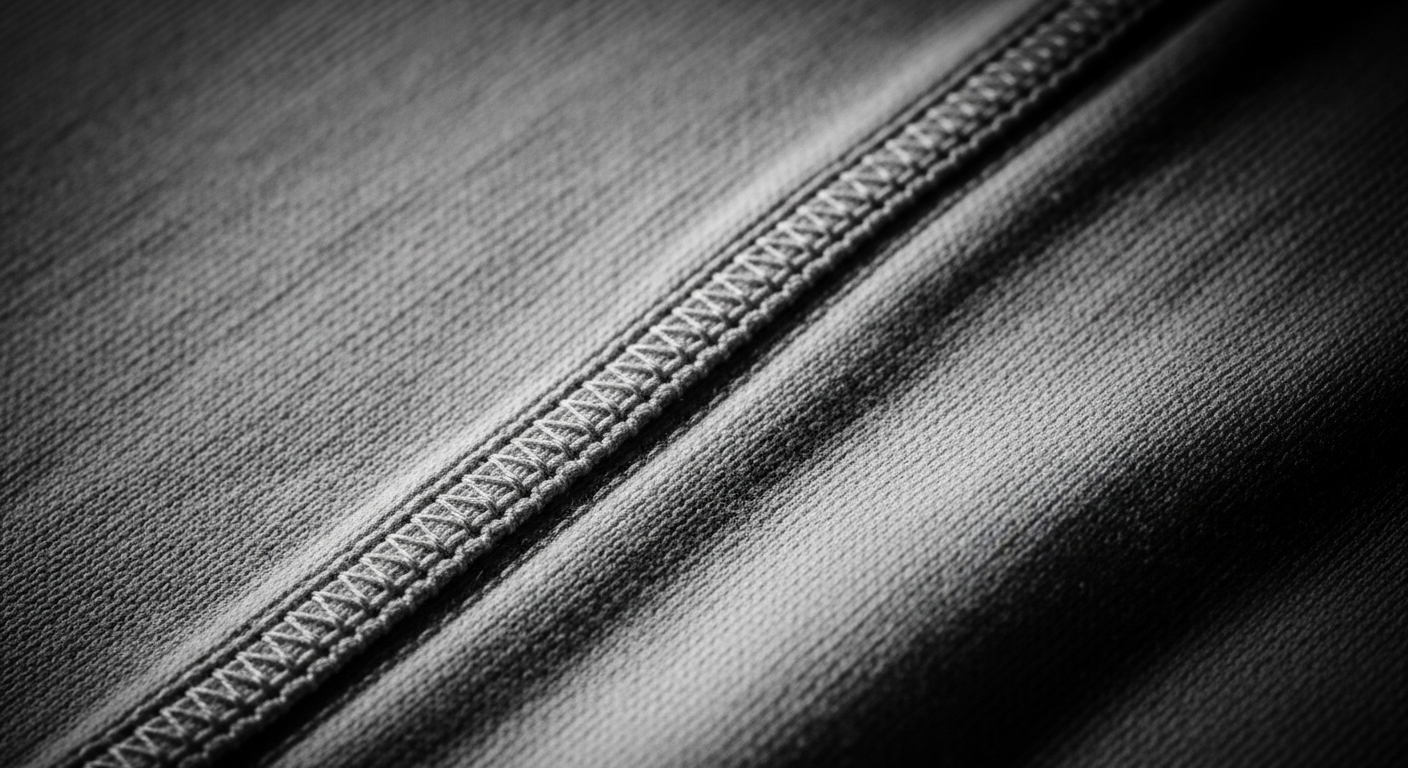
The seams of a garment are its structural system — the joins that hold the fabric together and determine how the garment holds up under the stresses of wearing and washing. Seam quality is one of the most reliable indicators of overall construction, because seam cutting is one of the places manufacturers most reliably cut costs.
Look for double-stitched seams — two parallel lines of thread, closely spaced, visible on the exterior — which significantly increase a seam's resistance to stress. Look for side seams running vertically from armhole to hem, rather than a tubular knit construction that is cheaper but less fitted and less durable. Feel the collar — a quality collar is reinforced with a separate ribbed piece that provides elasticity without rapid distortion. Check the hem — it should be even, consistent, and securely finished, without loose threads or signs of early unraveling.
If the context allows it, gently pull the seams in opposite directions across a few of the primary joins. Quality construction shows minimal stress response — the fabric should not pull or separate from the seam.
The Fourth Test — Print Quality and Durability Indicators
For graphic streetwear specifically, the quality of the print matters as much as the quality of the fabric, because the graphic is the primary expressive element of the piece, and its degradation is often what determines when the piece is no longer wearable.
Traditional screen printing, done with quality inks and proper process control, produces graphics with superior opacity, durability, and color consistency — the ink sits on the fabric with genuine physical presence you can feel when you run a finger across it. Direct-to-garment (DTG) digital printing has improved significantly, but tends to produce flatter prints that are less durable under repeated washing and more prone to fading, cracking, and loss of detail over time.
Run your finger across the print — a quality screen print has distinct physical presence, while DTG is typically flatter. Look at the edges — quality printing produces clean, sharp edges, while degraded printing shows softer, more irregular edges. Look at opacity in solid-color areas — quality opacity is consistent and shows no fabric texture through it. And where possible, look at reviews with photos of the garment after washing — the print's condition after wear is the most reliable indicator of its quality, and it is not visible on a new garment.
The Fifth Test — The Overall Presentation of Intention
Beyond the specific technical indicators above, experienced buyers develop a more holistic sense of a garment's overall intentionality — an integrated read of whether every element was considered, and whether the choices about fabric, construction, fit, and finishing are consistent with each other and with an overall vision of what the garment is supposed to be.
An intentional garment hangs consistently — the fabric weight is even across the piece, the seams sit at consistent tension, the collar sits without irregularity, and the print is placed precisely. An unintentional garment — one where shortcuts have been taken for cost reasons — tends to show small inconsistencies that are individually minor but collectively significant: slight variation in fabric weight, irregular seams, printing that is slightly off-center or misscaled.
This assessment cannot be fully reduced to a checklist, because it is the integrated perception of many small signals. But with the attention developed through the specific tests above, it becomes something you can assess with real reliability — and it is the quality that matters most, because caring about what you make is the condition from which every other quality choice emerges.
Applying This Guide to Online Purchases
Most streetwear is purchased online now, which removes direct access to the garment and requires relying on alternative signals.
GSM disclosure is itself a mild quality signal — a brand that discloses fabric weight is a brand that is not hiding it. Material composition matters too: "100% ring-spun cotton" or "combed ring-spun cotton" are positive signals, while significant polyester content in a piece sold as premium is worth further scrutiny. Construction specifications like "double-stitched seams" or "loopback interior" in a product description are positive signals; their absence means relying on brand reputation and review evidence.
Customer photographs in reviews — particularly of garments that have been washed and worn multiple times — are among the most reliable quality indicators available online. Look for reviews with photos of the garment worn and washed, not just posed on a flat surface. And pay attention to brand transparency generally: brands that are specific about their materials, factories, and quality standards are brands oriented toward quality rather than cost optimization.
The Honest Limit — What You Cannot Know Before You Buy
With all of the above in place, it is worth being honest about what cannot be assessed before purchase.
How the garment washes — the real test of fabric and construction integrity is what it looks and feels like after ten, twenty, fifty washes, which you simply cannot know in advance. How the print ages — whether it cracks, fades, or loses detail over time — can only be observed through wear or through the experience of others who have owned it long enough to see it happen. And how the garment fits after washing, since many pieces without adequate pre-shrinking distort in ways that affect wearability at the size purchased.
These limitations are real, and they are the reason brand reputation and review evidence matter. But the indicators above — fabric weight, yarn quality, seam construction, print quality, and overall intentionality — give you a substantially better foundation for evaluating quality than simply looking at a garment and trusting the price. With practice, they become a fast, reliable process that leads to consistently better decisions.
The point is not perfect information before purchase. It is better information, applied consistently, in service of building a wardrobe of pieces that are genuinely high quality — that last, that look right, that feel right — rather than pieces that looked right once and have been quietly declining ever since.
Unalienable Rights™ produces premium heavyweight rights-themed streetwear — ring-spun cotton, double-stitched construction, quality screen printing — held to the specific standards this guide describes. 10% of every purchase goes to the organizations protecting the rights each piece represents. Shop the Current Drop, read Our Mission, or explore more from the Journal.