Why More Consumers Are Looking for Fashion With Meaning
June 12, 2026
Something has changed in what people want from their clothes. Here's the honest, evidence-based account of why more consumers are seeking fashion with meaning.
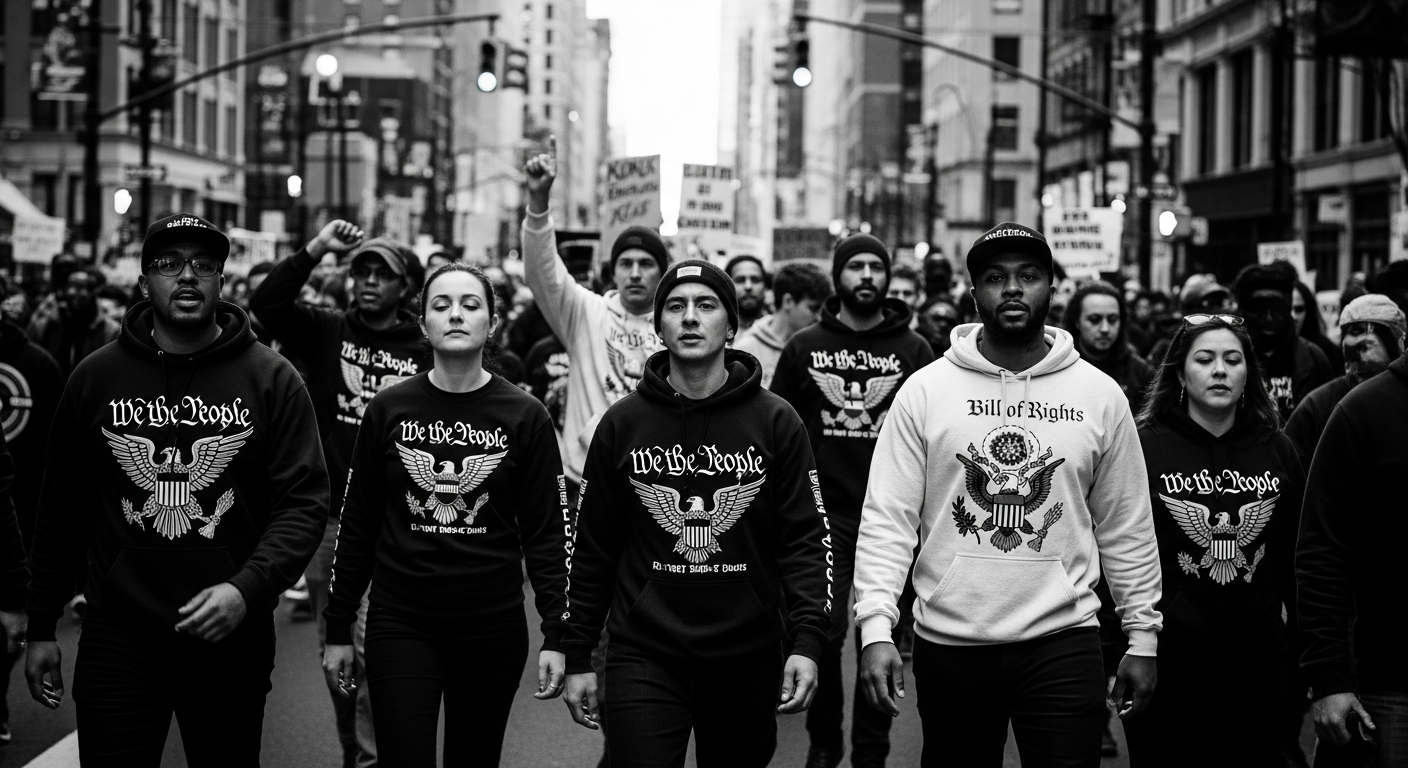
Ask someone what they want from a piece of clothing, and twenty years ago the honest answer — for most people, most of the time — would have centered on a relatively narrow set of considerations. Does it fit. Does it look good. Is it the right price. Does it suit the occasion.
Ask the same question today, and for a growing proportion of people, the honest answer includes something that would not have appeared on most lists twenty years ago at all: does it mean something. Does it represent something I believe. Does buying it connect me to something larger than the transaction itself. Does wearing it say something true about who I am — not just stylistically, but in terms of what I stand for.
This is not a small addition to the list of considerations. It is a different kind of consideration altogether — one that operates at a different level than fit, appearance, price, and occasion, because it is not asking what the clothing does for the wearer's appearance but what the clothing does for the wearer's sense of who they are and what they are connected to.
The rise of this consideration — the search for fashion with meaning — is one of the most significant and most underexplained shifts in consumer behavior of the past two decades. It is significant because it represents a genuine change in what a large and growing number of people want from one of the most universal and most frequent categories of purchase in their lives. And it is underexplained because most of the commentary on it treats it as a simple consequence of generational preference change — a habit of younger consumers that brands need to accommodate — rather than as something with deeper structural causes that require deeper structural responses.
This article is about those deeper conditions — about why, specifically, more consumers are looking for fashion with meaning right now, what "meaning" actually refers to in this context, and what the search for it tells us about the broader relationship between consumption, identity, and the specific historical moment we are living through.
What "Meaning" Actually Means in This Context
Before tracing why consumers are increasingly looking for fashion with meaning, it is worth being precise about what "meaning" refers to in this context — because the word, like "purpose" and "authentic" before it, risks becoming a vague gesture rather than a specific claim if it is not defined carefully.
"Meaning" in the context of fashion consumption refers to the degree to which a piece of clothing connects to something the wearer genuinely cares about beyond the clothing's immediate function and appearance — a connection that can take several specific forms.
It can be a connection to values — the sense that the clothing represents convictions the wearer genuinely holds, whether those convictions are about politics, the environment, social justice, or the philosophical traditions of human rights and dignity that this journal has explored extensively.
It can be a connection to community — the sense that the clothing connects the wearer to a group of people who share something significant, whether that group is defined by shared aesthetic sensibility, shared subcultural identity, or shared political and ethical commitment.
It can be a connection to consequence — the sense that the act of purchasing and wearing the clothing produces some effect in the world beyond the transaction itself, whether through charitable giving, through the support of specific production practices, or through the cultural visibility that the previous articles in this journal have explored.
And it can be a connection to narrative — the sense that the clothing is part of a story the wearer is telling about who they are, where they come from, what they have experienced, and where they are going — the Autobiographical dimension explored in the article on how clothing becomes part of identity over time.
What unites these different forms of meaning is that they all involve the clothing functioning as more than its immediate material and aesthetic properties — as a connection point to something larger, whether that something is a value system, a community, a consequence in the world, or a personal narrative. The search for fashion with meaning is the search for clothing that provides these connections — that does not just clothe the body but situates the person wearing it in relationship to something beyond the immediate transaction.
The First Driver — The Saturation of Pure Aesthetic Choice
The first and most foundational driver of the search for fashion with meaning is one that is rarely discussed because it requires acknowledging something uncomfortable about the experience of consumer abundance: the saturation of pure aesthetic choice has made aesthetic choice alone insufficient to produce satisfaction.
For most of the history of mass-produced fashion, the primary axis of differentiation between clothing options was aesthetic and functional — how things looked, how they fit, what they were made of, how durable they were, what occasions they were suited for. The consumer's task was to navigate this aesthetic and functional landscape to find pieces that satisfied their preferences within these dimensions.
The contemporary fashion market has made this navigation task almost infinitely easier and, in doing so, has revealed something about what was actually producing satisfaction in the navigation itself. When aesthetic and functional options are effectively unlimited — when any aesthetic preference can be satisfied almost immediately through online retail, when the global supply chain has made an almost unlimited range of styles, fits, and price points available to almost anyone — the satisfaction that the act of choosing produces declines. Not because the options are worse, but because the abundance has made the choice effortless, and effortless choice, paradoxically, is less satisfying than choice that required genuine effort and discrimination to make.
This is a specific instance of a more general phenomenon that has been observed across many domains of consumer choice: when a dimension of choice becomes saturated — when the options along that dimension become so abundant and so easily navigable that choice itself becomes effortless — the satisfaction that choice along that dimension can provide diminishes, and the search for satisfaction shifts toward dimensions that remain scarce and meaningful.
For fashion, the dimension that has remained scarce — that has not been saturated by the abundance of aesthetic and functional options — is meaning, in the sense defined above. The connection to values, community, consequence, and narrative that meaningful clothing provides is not subject to the same saturation dynamics as aesthetic choice, because it cannot be manufactured simply by producing more options. It requires genuine brands with genuine commitments, genuine communities with genuine shared values, genuine consequences in the world produced by genuine structural giving.
The search for fashion with meaning, from this perspective, is not a new desire that has appeared from nowhere. It is the redirection of the search for satisfaction toward the dimension that abundance has not yet exhausted — the dimension that remains genuinely scarce in a market where almost everything else has become abundant.
The Second Driver — The Erosion of Other Sources of Meaning and Belonging
The second driver is more sociologically significant and considerably more uncomfortable to discuss directly: the search for meaning through consumption, including fashion consumption, has intensified in part because other traditional sources of meaning and belonging have eroded for large segments of the population — particularly the generations driving the trend.
Sociological research on the decline of traditional institutions — religious affiliation, civic organisations, stable long-term employment relationships, geographically rooted multi-generational community — has documented a consistent pattern across multiple decades: the institutions that historically provided people with stable sources of meaning, identity, and belonging have become less prevalent, less stable, and less central to how people construct their sense of who they are.
This is not a uniformly negative development — many of these traditional institutions imposed constraints and exclusions that their decline has rightly addressed. But the decline has left a specific gap: the gap between the human need for meaning, identity, and belonging — which is a genuine and persistent need, not a cultural artifact that disappears when its traditional sources do — and the institutional structures that historically met that need.
Consumption has, to a significant degree, moved into this gap — not as a deliberate replacement strategy but as the consequence of consumption being one of the few remaining domains in which most people have meaningful agency to construct identity and signal belonging in a social landscape where other domains of identity construction have become less available or less stable.
For fashion specifically, this means that the search for fashion with meaning is, in part, the search for a substitute — however partial and however imperfect — for the meaning and belonging that other domains of life increasingly fail to provide. The brand that genuinely represents your values can provide a form of identity affirmation that institutions you might once have belonged to no longer provide. The community that forms around shared visible commitment to a brand's values can provide a form of belonging that is more available, more immediately accessible, and more structurally open than many of the institutional communities whose decline has created the gap.
This is not a flattering account of why people are looking for fashion with meaning, and it is worth being honest about its limitations. Clothing cannot actually replace the institutions whose decline has created the gap it is partially filling. The meaning and belonging that fashion can provide, even at its most genuine, is more limited and more fragile than the meaning and belonging that stable communities, institutions, and relationships can provide. But the honest acknowledgment of this limitation is itself part of what distinguishes brands that are genuinely trying to meet the need from brands that are simply trying to capitalize on it.
The Third Driver — Information Abundance and the End of Innocent Consumption
The third driver is the one explored in earlier articles in this journal in relation to the rise of purpose-driven consumerism specifically: the dramatic increase in available information about the consequences of consumption choices, which has made what might be called "innocent consumption" — purchasing decisions made without any awareness of their broader consequences — increasingly difficult to sustain.
The documentary and journalistic exposure of the human and environmental costs of fast fashion production — the Rana Plaza disaster, the documentaries and investigative reporting that followed it, the social media amplification that has made this information widely accessible — has produced a permanent shift in the epistemic environment within which fashion purchasing decisions are made.
This shift has a specific psychological consequence that is directly relevant to the search for fashion with meaning: once a person knows, even in general terms, that their clothing purchases have consequences — for the workers who made the clothing, for the environment, for the broader economic and political systems that the fashion industry is embedded in — the purely aesthetic and functional evaluation of clothing becomes, in a specific sense, incomplete. The consumer who knows about fast fashion's costs and makes a purely aesthetic purchase anyway is making a decision that creates a form of cognitive dissonance — a gap between what they know and how they are acting that produces a specific psychological discomfort, even when it does not produce a change in behavior.
Fashion with meaning — clothing from brands whose production practices, giving models, and values commitments have been considered and addressed — resolves this dissonance. It allows the purchasing decision to be made without the background awareness of unaddressed consequences that purely aesthetic and functional evaluation, in the current information environment, increasingly carries.
This driver explains part of why the search for fashion with meaning has intensified specifically over the period in which information about fashion's consequences has become widely available — and why it is concentrated, though not exclusively, in the demographic segments that have had the most exposure to this information.
The Fourth Driver — The Specific Political Moment
The fourth driver is the one most specific to the current historical moment, and it is the one most directly relevant to the specific territory that Unalienable Rights™ occupies: the search for fashion with meaning has intensified specifically in relation to political and civil rights content because the current political moment has made the visibility of commitment to those rights feel more urgent than it has at many previous points in recent history.
When the political and institutional environment feels stable — when the rights and protections that constitute the baseline of a functioning democratic society feel secure and uncontested — the impulse to make visible commitment to those rights feels less urgent. The rights are simply assumed; making them visible through what you wear does not feel like it is doing anything, because there is nothing visible to do anything about.
When the political and institutional environment feels less stable — when freedom of expression is documented to be under pressure from multiple directions, when civil liberties protections are being tested by institutional practices that push against their traditional boundaries, when the gap between the philosophical commitment to equal justice and its political reality feels more visible and more consequential than it has in recent memory — the impulse to make visible commitment to these rights intensifies, because the visibility itself feels like it is doing something: contributing to the cultural environment in which the contested rights are defended.
This driver is specific to the current moment in a way that the other three drivers are not — it is not a structural feature of contemporary consumer culture that will persist regardless of political conditions, but a response to the specific political conditions of the present. But it is also, for that reason, one of the most significant drivers of the search for fashion with meaning in the specific category — rights-based, civil liberties-focused, constitutional-rights-themed activist clothing — that this journal is concerned with.
What the Search Reveals About the Search
Taken together, these four drivers — the saturation of pure aesthetic choice, the erosion of other sources of meaning and belonging, the end of innocent consumption, and the specific political moment — reveal something about the search for fashion with meaning that is worth stating directly: the search is not primarily about fashion.
It is about meaning. Fashion is simply one of the domains — accessible, frequent, personal, and publicly visible — in which the search for meaning is being conducted, because fashion happens to be a domain that most people engage with regularly, that allows genuine self-expression, and that has, as this journal has explored extensively, genuine capacity to connect individual choices to values, community, consequence, and narrative.
This reframing matters because it changes the standard against which "fashion with meaning" should be evaluated. If the search were primarily about fashion — about finding clothing that looks different or signals a different aesthetic category — then the bar for "meaning" would be relatively low: any clothing with explicit values content would satisfy the search, regardless of whether the values content was genuine.
But if the search is primarily about meaning — about finding genuine connection to values, community, consequence, and narrative that other domains of life are increasingly failing to provide — then the bar is considerably higher. Clothing that deploys the aesthetic of meaning without the substance does not satisfy the search, because the search was never really about the aesthetic. It was about the substance, and clothing that provides only the aesthetic of substance will, for consumers who are genuinely searching for meaning rather than for the look of meaning, ultimately fail to satisfy what they were actually looking for.
What This Means for Brands — And for Unalienable Rights™
For brands operating in the space that this journal has been exploring across many articles — purpose-driven fashion, rights-themed activist streetwear, premium ethical clothing — the analysis in this article has a specific and significant implication: the search for fashion with meaning is not a trend to be capitalized on through positioning. It is a genuine human need that has found its way, for the reasons described above, into the domain of fashion consumption — and meeting that need genuinely requires providing genuine meaning, not the aesthetic of it.
This is the foundation of everything Unalienable Rights™ has been built around — the structural giving, the genuine engagement with the philosophy and history of unalienable rights, the community formation that this journal and the brand's broader presence are designed to support, and the honest acknowledgment, repeated across many articles, of where the brand's contribution is genuine but partial relative to the scale of what the underlying causes require.
The search for fashion with meaning is, ultimately, a search for connection — to values that matter, to people who share those values, to consequences that make the values real in the world, and to a story about who you are that includes genuinely holding convictions and genuinely acting on them. Clothing can provide this connection. It cannot manufacture it. The brands that understand this distinction — that build genuine connection rather than manufacturing its appearance — are the brands that will, over time, be recognized as having actually answered the search that more and more consumers are conducting.
We are trying to be one of those brands. The search for fashion with meaning is the search we are trying to answer — not through positioning, but through the structural commitments, genuine engagement, and honest community-building that meaning, in its genuine form, actually requires.
---
Unalienable Rights™ exists for people who are looking for fashion with genuine meaning — not the aesthetic of it. Premium limited-edition rights-themed streetwear, genuine structural giving, genuine engagement with the history and philosophy of unalienable rights. 10% of every purchase to the organisations protecting the rights each piece represents.
→ Shop the Current Drop → Our Mission → More from the Journal